

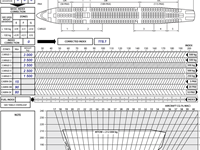
Determine the zero fuel mass CG, given the data from the annex.

Refer to figure.
Start at the top at an index of 119.1. Track vertically down to the guideline in the tape “Cargo 1”. Each small line represents 500 kg. If 3 000 kg is loaded into cargo hold 1, this mass corresponds to 6 increments. The arrow in the box indicates the direction to move to adjust for that mass. The same procedure also applies to all the remaining cargos and all passenger section loading.
The last row is designed to adjust the fuel load effect on the centre of gravity. In this case, we are looking for the zero fuel mass CG. Therefore, we can simply track vertically down through the fuel index tape and continue down into the graph.
Draw a horizontal line at the zero fuel mass of 137 875 kg.
The point of intersection of both lines will corresponds to the zero fuel mass CG: it lies in between lines “31” and “32”, which gives the ZFM centre of gravity position of approx. 31 % of the MAC.
- Closest option: 31.3%
Your Notes (not visible to others)
This question has appeared on the real examination, you can find the related countries below.
-
Greece2
-
Iceland1
-
Italy1
-
Luxembourg1
-
Poland1
-
Romania1


 Use Keyboard Shortcuts
