

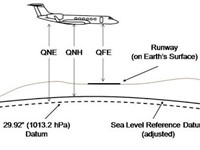
Refer to figure.
QNH = The atmospheric pressure adjusted to mean sea-level.
If you are on the ground at an airport and turn in the local QNH at your altimeter’s subscale, it will display the airports altitude above mean sea level.
QFE = The pressure set on the altimeter so that it indicates the height above the reference elevation being used (height above current ground level).
If you set the QFE on your altimeter’s subscale on the ground, the altimeter would read 0 feet.
So, it is used to get to know the height above the ground.
QNE =The indicated altitude at the landing runway threshold when 1013,25 is set in the altimeter’s subscale.
In other words, it is the pressure altitude at the landing runway threshold.
QFF = Mean sea level pressure, derived by taking into account the actual temperature conditions.
So, the QFE reduced to mean sea level with regard to the actual outside air temperature.
In the case of this specific question: QNH can be equal to QFE when the airport is situated at sea level.
The QNH would be 1013.2 because the altitude above sea level is 0. QFE would be 1013.2 too, because there is 0 elevation compared to the sea level.
So, the values are the same.
Your Notes (not visible to others)
This question has appeared on the real examination, you can find the related countries below.


 Use Keyboard Shortcuts
