

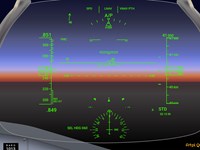
Refer to figure.
Note: There is no learning objective for this in operational procedures, but the feedback was initially for this subject. It would be better placed in instrumentation, so we have copied it over to that subject also as question 221336. Please let us know if you see it in the exam, and which exam that was, thank you!
Looking at the answer options:
Enhances passenger comfort and reduces cockpit workload → INCORRECT. The HUD is used by pilots, not by passengers.
Increases fuel efficiency and decreases engine wear → INCORRECT. The HUD displays information as found on the PFD (Primary Flight Display) which enables the pilot to fly the aircraft. This has no effect on engine wear or really fuel efficiency.
Enables satellite communication and weather radar display → INCORRECT. The weather radar is displayed on the Navigation Display (ND) and the HUD plays no role in SATCOM.
Provides an indication of the runway position and displays autopilot modes → CORRECT. The HUD can display both the runway position and also the various modes of the autopilot.
A Head-Up Display (HUD) is a means of presenting information to the pilot in the line of their external forward vision which projects key flight instrument data onto a small ‘see-through’ screen positioned just in front of the pilot line of sight looking ahead out of the aircraft.
It is therefore used for pilot awareness only, and provides no extra information that cannot already be found in the flight deck, but it does reduce workload and increase capacity for more critical stages of flight, where visual reference to the outside world is important, but the pilots also need information from their instruments. When combined with synthetic vision, for example, it can be very useful for showing the pilots the location of the runway, even when they are flying IMC.
Your Notes (not visible to others)
This question has appeared on the real examination, you can find the related countries below.
-
Switzerland2
-
Austro Control1
-
Hungary1
-
Spain1


 Use Keyboard Shortcuts
