

You are carrying out an approach, you are on glideslope to land, and you encounter a microburst on your flight path and to the right. What effects does the aircraft suffer?
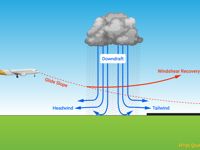
Refer to figure.
An aircraft approaching a downburst will first encounter a strong headwind, which will lead to an increase in indicated airspeed.
When the microburst is to the right of the aircraft – it will push the aircraft to the left, causing the aircraft to drift to the left.
The above-mentioned strong headwind causes an increase in lift (rate of descent decreases). Therefore, considering that you were established on the glideslope, you will now be above it.
Your Notes (not visible to others)
This question has appeared on the real examination, you can find the related countries below.
-
United Kingdom19
-
Poland10
-
Spain10
-
Germany4
-
Austro Control3
-
Ireland3
-
Croatia2
-
Hong Kong1
-
Hungary1
-
Malaysia1
-
Pakistan1
-
Romania1
-
Slovakia1
-
Switzerland1


 Use Keyboard Shortcuts
