

Refer to figure.
A pilot operating on the single engine fleet for European Airlines is calculating landing performance. Given the following information, what distance should the pilot use to enter the landing distance graph, to obtain the maximum permissible landing mass?
Landing distance available: 3150 ft
Runway surface: Paved
Runway condition: Wet
Runway slope: 1.4% downslope
Refer to figure.
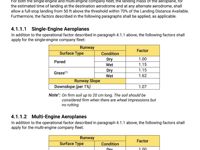
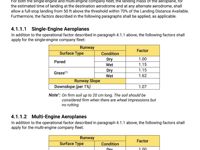
Using the data from the annex, we can see that the landing performance must first be factored for the wet paved. The pilot is on the single-engine fleet of aircraft, so using that value, it is a factorisation of 1.15. This reduces the aircraft performance, so the landing distance available must be divided by 1.15 to give the corresponding "wet paved" runway distance for entry into the performance graphs, making the new value;
3150 / 1.15 = 2739 ft
In same way, we can see that the landing performance factored for the downslope. The landing distance increased by 7% for each 1% downslope.
For 1.4% downslope → 0.07 x 1.4 = 0.098 → 1.098 factor.
So the landing distance available must be divided by 1.098 ⇒ 2739 / 1.098 = 2495 ft
The landing distance available can also not be assumed to be fully used by the aircraft on landing. Due to the fact this is a commercial air transport operation, the top paragraph in the annex dictates that only 70% of the LDA can be used for performance calculations, allowing for a safety margin. Therefore, the figure must also be multiplied by 0.7.
Therefore, the landing distance to enter into the performance graphs is 2495 ft x 0.7 = 1746 ft
Your Notes (not visible to others)
This question has appeared on the real examination, you can find the related countries below.
-
France7
-
Spain5
-
Romania4
-
Lithuania2
-
Austro Control1
-
Czech Republic1
-
Portugal1
-
Slovakia1


 Use Keyboard Shortcuts
