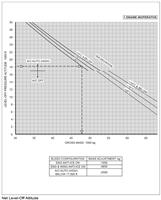
Considering the effect of density on VMCG only, How does a high-altitude runway affect the V1, the take-off distance, and the landing distance?
-
A
V1 – decreases; take-off distance – increases; landing distance – increases.
-
B
V1 – decreases; take-off distance – decreases; landing distance – decreases.
-
C
V1 – increases; take-off distance – decreases; landing distance – decreases.
-
D
V1 – increases; take-off distance – increases; landing distance – increases.
AIR DENSITY
As air density decreases (altitude increases), both engine and aerodynamic performance decrease.
Aircraft performance depends on air density, which directly affects lift and drag, engine power, and propeller efficiency. As air density decreases (altitude increases), both engine and aerodynamic performance decrease.
- Take-off distance
When an aircraft is taking off at a pressure altitude above ISA sea level, it will still get airborne at the same indicated airspeed (IAS) as at sea level, but because of the lower air density the true airspeed (TAS) will be greater. To achieve this higher speed with the same engine power, a longer take-off run will be needed.
- Landing distance
Because of the lower air density, the same Indicated airspeed will have a higher True Airspeed (TAS), which will result in an increased landing run.
- V1
V1 cannot be allowed to be less than VMCG because engine failure below VMCG means the airplane is uncontrollable and the definition of V1 is that the take-off can be continued following engine failure. At higher altitudes, the air is less dense, which results in a decreased VMCG. Additionally, because of the higher TAS, the decision to stop/go must be made at a lower IAS. Consequently, V1 will also decrease.
Your Notes (not visible to others)
This question has appeared on the real examination, you can find the related countries below.
-
Austro Control4
-
United Kingdom4
-
France3
-
Germany3
-
Poland2
-
Thailand1