

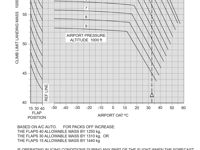
Refer to figure or CAP698 figure 4.29.
Determine the Landing Climb Limit for a Medium Range Jet Transport aircraft, given the following information for the landing aerodrome:
OAT: -20°C
PA: 4000 ft
AC: Auto
Flaps: 40°
Anti-ice: OFF
Icing conditions were experienced during the flight
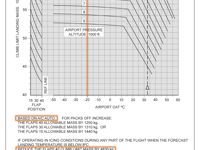
Refer to figure.
The Landing climb requirement is for a missed approach, should an engine become inoperative. We need to be assured that the aircraft can clear obstacles when climbing on a single engine at the current mass. We use the chart as follows:
- Enter with the OAT of -20°C and draw a vertical line up to the pressure altitude of 4000 ft
- Draw a horizontal line to the left, to the flaps reference line. With Flaps 40, we do not need to follow the guidelines any further, so can proceed through this refence line to read off the climb limit mass of 60 000 kg
- The graph is based on AC Auto, so we don't have to apply any AC correction
- Because icing conditions were experienced during the flight, and the forecast landing temperature is less than 8°C we must decrease the Flaps 40 climb limit mass by 4830 kg
- Although Icing condiitons were experienced during the flight, it seems that they are not expected during landing and the anti-ice is OFF. There is no further correction to apply for anti-ice operation.
The Climb Limit Mass is therefore: 60 000 - 4830 = 55 170 kg.
Your Notes (not visible to others)
This question has appeared on the real examination, you can find the related countries below.
-
United Kingdom2
-
Spain1


 Use Keyboard Shortcuts
Use your keyboard for faster navigation
