

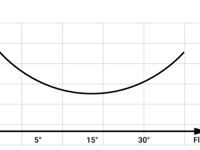
Consider the effect of increasing take-off flap setting from 5° to 15°. How does this affect take-off performance? Why is there an optimal setting?
-
A
Increases runway-limited weight, decreases climb-limited weight, decreases obstacle clearance weight; optimal setting balances these.
-
B
Decreases runway-limited weight, increases climb-limited weight, increases obstacle clearance weight; higher flap always better.
-
C
No effect on runway limit, increases climb limit, no effect on obstacles; flaps only affect landing.
-
D
Increases both runway and climb limits equally; any setting works.
Refer to figures.
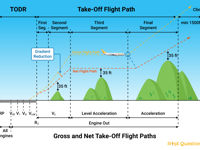
Trailing edge flaps change the coefficient of lift of a wing by changing its camber (shape). The changing shape of the wing also affects the total drag. When trailing edge flaps are used at takeoff settings, they typically decrease the ground roll distance (TOR) but they also decrease the climb gradient. The optimum flap setting for a given departure depends both on the runway distances available, as well as the required climb gradients and obstacle clearance.
For take-off, lower flap settings are typically used. This is because:
- Lower flap settings (e.g. 1° - 15°) lead to a large increase in lift for only a small increase in drag. The result of using small flap deflections for takeoff, is a decrease in the TOD. The aircraft can become airborne and climb to the screen height at a lower airspeed due to the increased CL
- Higher flap settings (e.g. 15° - 40°) lead to only a small increase in lift for a large increase in drag. These flap settings are not used for take-off.
Within the acceptable range of take-off settings, increasing flaps from 5° to 15° will have the following effects:
- Increased runway-limited weight - the higher flap setting reduces the TOD, allowing more weight to be carried for the same runway length
- Decreased climb-limited weight - the higher flap setting increases drag. Assuming the thrust doesn't change, the excess thrust (thrust - drag) is reduced. This reduces the climb angle, meaning less weight can be carried to comply with minimum climb gradients.
- Decreases obstacle clearance limited weight - Due to the reduced climb gradient, obstacle clearance on the NTOFP is usually reduced. It is typically limited most in the second segment, which is climb gradient dependent.
The maximum takeoff mass (MTOM) will be the lowest of the above masses. The optimum flap setting gives us the highest possible MTOM, by balancing take-off performance across these areas.
Your Notes (not visible to others)
This question has appeared on the real examination, you can find the related countries below.


 Use Keyboard Shortcuts
