

Complete the following statements with respect to wing planform and initial stall sequence. The initial stall tendency is that a rectangular wing (1) _____, an elliptical wing (2) _____, a moderately tapered wing (3) _____, and a swept wing with high taper (4) _____.
-
A
(1) stalls first at the wing tip; (2) stalls evenly along the wing; (3) stalls first at the mid-span; (4) stalls first at the wing root
-
B
(1) stalls first at the wing root; (2) stalls first at the wing root; (3) stalls first at the wing tip; (4) stalls evenly along the wing
-
C
(1) stalls first at the wing tip; (2) stalls evenly along the wing; (3) stalls first at the wing tip; (4) stalls first at the wing tip
-
D
(1) stalls first at the wing root; (2) stalls evenly along the wing; (3) stalls first at the mid-span; (4) stalls first at the wing tip
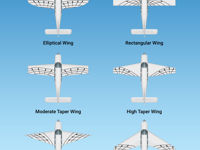
Refer to figures.
Learning Objective 081.03.01.03.01: Explain the initial stall sequence on the following planforms: elliptical; rectangular; moderate and high taper; sweepback or delta.
Wing planform describes the 2D shape of the wing, when viewed from above. The planform is an important design parameter, particularly with regard to stalling characteristics. This is because different planforms lead to different amount of spanwise flow - which influences wingtip vortices and effective angle of attack. The effective angle of attack may vary along the wingspan, leading to the stall occurring at different points along the wing depending on the planform.
Rectangular Wing
A rectangular wing is a simple design used on many light aeroplanes, and some larger aeroplanes. The chord remains constant along the wingspan. Due to the pressure difference above and below the wing, and the relatively large wingtip, there is significant spanwise flow and relatively strong wingtip vortices for rectangular wings. As a result, the effective angle of attack at the wingtips is lower. For a given AoA, the effective AoA is therefore higher at the wing roots - which exceed the critical AoA and stall first for this wing type.
Elliptical Wing
An elliptical wing is designed to minimise induced drag and spanwise flow. The wing is shaped like an ellipse, and the planform area reduces along the span. As a result, the effective AoA is approximately constant along the span, so the stall occurs evenly along the wing.
Tapered Wing
A tapered wing is a simpler design compared to an elliptical wing, but with reduced induced drag compared to a rectangular wing. This is achieved by reducing the chord along the span, therefore reducing the relative size of the wingtips. There are smaller vortices, and the effective AoA is more even along the wing.
- For moderate taper, the wing stalls first at the mid-span of the wing
- For high taper angles, the wing stalls first at the wing tips
Swept Wings
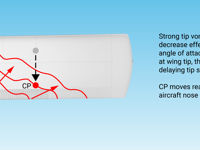
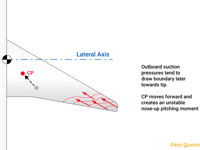
Wing sweep is highly effective at increasing MCRIT and the drag divergence Mach number, improving the high speed characteristics of a wing. It comes however, with a significant downside regarding stall characteristics. Because of the sweep, spanwise flow is suppressed. The wingtips have the highest effective AoA, and stall first. This is exacerbated by wings which are both swept and tapered. The tip stall tendency on swept wings results in a rapid forward motion of the centre of pressure, which creates a nose-up pitching moment, further increasing the AoA and worsening the stall.
Your Notes (not visible to others)
This question has appeared on the real examination, you can find the related countries below.
-
United Kingdom22


 Use Keyboard Shortcuts
