

-
A
the sequence of events in which the RF energy goes from zero to maximum positive, to zero, to maximum negative and returns to zero forming a single wave.
-
B
the fraction of one wavelength expressed in degrees from 000° to 360°.
-
C
the angular difference between the corresponding points of two cycles of equal wavelength, which is measurable in degrees.
-
D
the number of complete cycles formed per second.
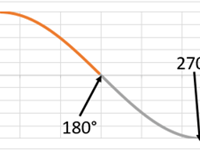
Learning Objective 062.01.01.02.05: Define ‘phase angle’: the fraction of one wavelength expressed in degrees from 000 degrees to 360 degrees.
As mentioned in the above learning objective, "phase" is a way to measure the position within a wave cycle. For instance, the first quarter of a wave cycle (from equilibrium up to the first peak, for example) is a phase of 1/4, but as we measure phases in terms of angles, it is 90º (1/4 of 360º). This means that a whole wave cycle makes up 360º of phase, which would represent a full circle, which is correct as circles are closely linked to waves.
Phase can either dictate a position within a wave, or a "distance" within a wave, for instance a peak and a trough are 180º different in phase. It can also, in the same way, compare the timings of two waves (of the same frequency), called phase difference.
Phase difference can tell us that two similar waves are at different points during their wave cycles, so if two waves were 180º out of phase, one would be at a peak and the other would be at a trough at the same time.
In this question though, we are talking about "phase" only, not phase difference, so it is the first of these, the position within a wave cycle, expressed as an angle from 0-360º
Your Notes (not visible to others)
This question has appeared on the real examination, you can find the related countries below.
-
Sweden3
-
Azerbaijan1
-
Thailand1


 Use Keyboard Shortcuts
