

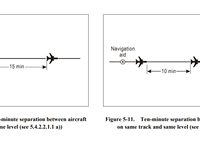
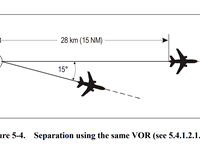
Refer to figures.
ICAO Annex 11
3.3 Operation of air traffic control service
3.3.5 Separation by an air traffic control unit shall be obtained by at least one of the following:
b) horizontal separation, obtained by providing:
1) longitudinal separation, by maintaining an interval between aircraft operating along the same, converging or reciprocal tracks, expressed in time or distance; or
2) lateral separation, by maintaining aircraft on different routes or in different geographical areas;
Horizontal separation may be established in two ways:
- By time (e.g. maintaining a specified number of minutes between aircraft), or
- By distance (e.g. maintaining a specified number of nautical miles between aircraft).
Distance-based separation may be measured using various surveillance or navigation techniques (such as DME, radar, or GNSS), but the separation itself is always expressed as a distance, not as the equipment used to measure it.
Likewise, speed is not a type of horizontal separation. Controllers may issue speed restrictions to help establish or maintain the required time or distance separation, but speed is a control technique, not a separation standard in its own right.
Don't confuse separation methods with ATC techniques:
Time → a valid horizontal separation standard.
Distance (NM) → a valid horizontal separation standard.
Speed → used to achieve or maintain separation, but is not a type of separation.
DME distance → DME is simply one way of measuring distance; the separation standard itself is still distance (NM).
Your Notes (not visible to others)
This question has appeared on the real examination, you can find the related countries below.
-
Austro Control4
-
Ireland3
-
Czech Republic2
-
France2
-
Poland2
-
Portugal2
-
Spain2
-
Switzerland2
-
United Kingdom2
-
Greece1
-
Sweden1


 Use Keyboard Shortcuts
