

What options are correct regarding topple and drift of a gyro?
1. Drift relates to the gyro’s spin axis movement along the horizontal plane
2. Topple relates to the gyro’s spin axis movement along the horizontal plane
3. Topple relates to the gyro’s spin axis movement along the vertical plane
4. Drift relates to the gyro’s spin axis movement along the vertical plane
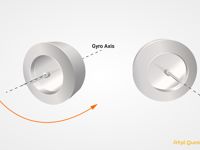
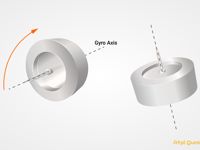
Refer to figures.
The simplest form of gyroscope (or gyro) consists of a rapidly spinning disc (called a rotor). Any rapidly spinning symmetrical rotor exhibits gyroscopic properties:
- Precession: When an external force is applied to the spinning rotor via the gimbal assembly, the gyro does not move in the direction of the force, but in a direction perpendicular (90° later) to that of the applied force.
- Rigidity: Rigidity is the gyro’s property of maintaining its axis in a fixed direction in space unless subjected to an external force. It is caused by the inertia of the spinning mass.
The shaft about which the rotor spins is called the axis. Gyros are defined in their orientation as either horizontal or vertical by reference to the spin axis, not the rotor.
Despite the property of rigidity, the orientation of a gyro axis may alter over time. Any departure of a gyro axis from its original orientation is called wander. Wander may be either real or apparent (the difference is explained below) or a combination of both. Wander is subdivided into drift and topple.
If the gyro axis wanders in the horizontal plane, it is called drift, either real or apparent. (figure 1)
If the gyro axis wanders in the vertical plane, it is called topple, either real or apparent. (figure 2)
Your Notes (not visible to others)
This question has appeared on the real examination, you can find the related countries below.
-
Austro Control12
-
Germany5
-
Denmark1
-
Romania1


 Use Keyboard Shortcuts
