

The principle of the compass swinging procedure is to…
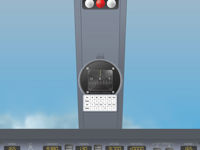
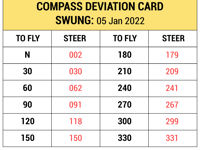
Refer to figure.
EASA learning objective 022.03.02.01.02 states: ‘Explain the principles of and the reasons for: compass swinging (determination of initial deviations); compass compensation (correction of deviations found); compass calibration (determination of residual deviations).’
EASA learning objective 022.03.02.01.03 states: ‘Explain how permanent magnetism within the aircraft structure and electromagnetism from the aircraft systems affect the accuracy of a compass.’
The direct reading compass (DRC) aligns itself with the Earths magnetic field and should theoretically point to magnetic North. Unfortunately an aircraft has its own magnetic field, generated by its component parts, which can cause a difference between where the compass points to and Magnetic North! This direction is known as Compass North and the difference between Compass North and Magnetic North is called deviation.
Aircraft magnetic fields can be generated by ferromagentic materials used in airframe components or electromagnetism caused by electrical equipment. There are two types of magnetism associated with ferromagnetic material:
- Hard iron magnetism (Permanent) - refers to materials which once magnetised retain their magnetism.
- Soft iron magnetism (Temporary) - refers to materials which are easily magnetised but retain little or no magnetism when the magnetic field is removed.
Compass Swing
The deviations caused by hard and soft iron aircraft magnetism (incuding electromagnetic) needs to be corrected for as much as possible to minimise the amount of deviation. Deviation will vary with aircraft heading due to the orientation of the aircraft magnetic field in relation to the Earths magnetic field.
A compass swing compares the DRC compass heading with magnetic North, by taxying the aircraft in a circle onto various cardinal headings, to determine the amount of deviation. Many airfields have a specific area for this called the ‘compass base’. The deviation is then corrected by compensating magnets built into the DRC. After the compass has been compensated it is then calibrated to determine any residual deviation. The residual deviation is recorded on a deviation card which is placed near the DRC to allow pilots to fly the correct magnetic heading.
(Note: This is an old question, the terms ‘hard iron magnetism’ and ‘soft iron magnetism’ are no longer referred to in the LO, they've been replaced by ‘Permanent’ and ‘Electromagnetic’ (temporary) magnetism.)
correct for deviation due to hard iron magnetism only → INCORRECT. Soft iron (temporary) magnetism also causes compass deviation.
correct for deviation due to soft and hard iron magnetism → CORRECT. Deviation due to soft and hard iron magnetism together with electromagnetism need to be corrected for.
determine the amount by which the compass readings are affected by hard and soft iron magnetism → INCORRECT. The compass swing procedure includes compass correction and calibration in addition to the determination of initial deviation.
correct for deviation due to soft iron magnetism only -→ INCORRECT. Hard iron (permanent) magnetism also causes compass deviation.
Your Notes (not visible to others)
This question has appeared on the real examination, you can find the related countries below.
-
France3
-
Austro Control1
-
Ireland1
-
Slovakia1


 Use Keyboard Shortcuts
