

Your aircraft is in a climb to FL90 with the autopilot engaged. As you climb through FL75 ATC asks you to stop climb at FL80. What is the most appropriate action to take?
-
A
Disconnect the autopilot and manually level off the aircraft at 8000 ft to prevent overshoot.
-
B
Ignore the new clearance and continue to FL090, since it was previously cleared.
-
C
Maintain current vertical speed and select FL080 once passing FL079 to minimize workload.
-
D
Promptly adjust the autopilot target altitude to FL080 and monitor vertical speed to avoid level bust.
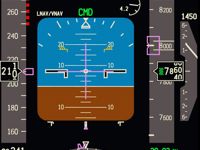
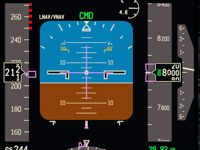
Refer to figures.
EASA learning objective 022.06.02.01.17 states: 'Describe the sequence of events when a mode is engaged and the different phases: initial phase where attitude is changed to obtain a new trajectory in order to achieve the new parameter; the trajectory will be based on rate of closure which is again based on the difference between the original parameter and the new parameter; capture phase where the aircraft will follow a predefined rate of change of trajectory to achieve the new parameter without overshooting/ undershooting; tracking or hold phase where the aircraft will maintain the set parameter until a new change has been initiated.
The question doesn't state the rate of climb but given the proximity to FL90 you can assume that the rate is no more than 1500 fpm so you've got at least 20 seconds to make your selections on the Mode Contol Panel (MCP).
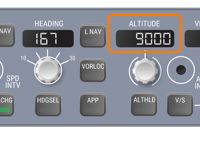
If we take the Boeing 737 AFCS as an example you'd currently have 9000 ft set in the altitude window on the MCP (see figure) and the autopilot will be controlling the speed in level change (LVL CHG) mode with the autothrust holding climb thrust. When approaching the desired level the autopilot enters altitude aquire (ALT ACQ) mode and lowers the nose to reduce the rate of climb while the autothrust drops into speed mode as the aircraft levels off. The autopilot will then change to altitude hold mode (ALT HOLD) and the speed in the cruise will be controlled by thrust.
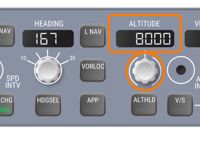
A sudden change of cleared level with 500 ft to go requires a prompt change of the altitude window setting on the MCP to 8000 ft (see figure) to allow the autopilot time to adjust the rate of climb while keeping the negative accleration within prescribed limits. The threat here is that while keeping within these limits the autopilot might slightly overshoot FL80 before returning to that level.
Disconnect the autopilot and manually level off the aircraft at 8000 ft to prevent overshoot ---> INCORRECT. The autopilot can fly the aircraft more accurately than you, by the time you've reacted you'll over compensate and upset the passengers!
Ignore the new clearance and continue to FL090, since it was previously cleared ---> INCORRECT. ATC changed your clearance for a reason, you can't just ignore it!
Maintain current vertical speed and select FL080 once passing FL079 to minimize workload ---> INCORRECT. The autopilot will not be able to level you off in time guaranteeing a level bust!
Promptly adjust the autopilot target altitude to FL080 and monitor vertical speed to avoid level bust ---> CORRECT. If you're prompt this will work just fine and temporarily overshooting by 200 ft or less is allowable.
Your Notes (not visible to others)
This question has appeared on the real examination, you can find the related countries below.


 Use Keyboard Shortcuts
