

Mountain waves have been observed over the Pyrenees Mountains, therefore, at the windward side, the layer of the air mass at the ridge line is (1) _____. In the air mass above the mountains wind speed will (2) _____ with height and the wind direction will (3) _____ with height.
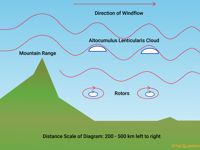
Refer to figure.
Mountain waves form when air is pushed upwards by a mountain barrier on the windward side and then descends on the leeward side due to specific atmospheric conditions. This creates standing waves downstream of the barrier, with the most intense turbulence typically found at lower levels, particularly leeward of the mountains near or within the rotor cloud, if present.
On the windward side of the mountain, the following conditions are present for mountain waves to form:
- Wind direction: generally perpendicular (+/-30°) fashion, raised up over the mountains. And no significant change in direction with altitude.
- Wind speed: strong. At least 20 kt at summit level, increasing with altitude.
- Marked layer of stability, often with an inversion around altitude of summits – which will work as a barrier over the mountains.
If these conditions exist, the resulting waves can extend for hundreds of miles downwind of the mountain range. These waves can even extend well above the tropopause, reaching altitudes as high as FL600.
Your Notes (not visible to others)
This question has appeared on the real examination, you can find the related countries below.
-
France87
-
Austro Control4
-
Ireland3
-
Germany2
-
Norway2
-
Poland2
-
Romania2
-
Czech Republic1
-
Denmark1
-
Finland1
-
Latvia1
-
Luxembourg1


 Use Keyboard Shortcuts
