

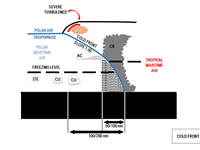
Refer to figures.
COLD FRONT. Can be defined as cold air replacing warm air.
The denser cold air displaces/overtakes the less dense warm air => cold air will slide itself under the warm air, forcing it to rise.
Conditions in a Passing Cold Front
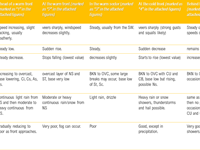
As the cold front passes, towering cumulus or cumulonimbus clouds are present. Depending on the intensity of the cold front, heavy rain showers form and might be accompanied by lightning, thunder, and/or hail. During cold front passage, the visibility is poor, with winds variable and gusty, and the temperature and dew point drop rapidly. A quickly falling barometric pressure steadies during frontal passage and then begins a gradual increase. An aircraft flying through a front which is moving in the opposite direction will experience the wind veering. Conversely, if the aircraft is moving in the same direction as the front, the wind will back.
Conditions When the Cold Front has Passed.
After the frontal passage, the towering cumulus and cumulonimbus clouds begin to dissipate to cumulus clouds with a corresponding decrease in precipitation. Good visibility eventually prevails, temperatures remain cooler and the barometric pressure continues to rise.
Your Notes (not visible to others)
This question has appeared on the real examination, you can find the related countries below.
-
Austro Control2
-
Ireland1
-
Sweden1


 Use Keyboard Shortcuts
