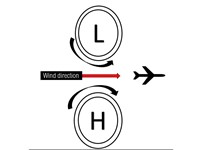
Wind speed in case of gradient wind is…
Refer to figure.
GRADIENT WIND
The gradient wind is similar to geostrophic wind, which is where wind flows along straight isobars. That is a rarity though, and more often, isobars are curved, meaning that the wind is turning. This introduces imbalanced forces, which cause this turning of the wind, and is instead called the "gradient wind".
Note: There are a couple of different ways to reason and understand gradient winds, centrifugal force and centripetal force. Centrifugal force is not actually a force at all, it is the effect of inertia in a turn. Nonetheless, you may have learnt either of these two ways. We believe centripetal force is slightly easier to explain in text format, so we will do that in the further explanation below
If you wish to take the easy route here, remember that, for the same isobar spacing (same PGF), gradient wind speed is LOW around a LOW, and HIGH around a HIGH. This means the wind is slower when turning around a low pressure zone (cyclone) and faster around a high pressure zone (anticyclone). This should be sufficient for the vast majority of questions.
The gradient wind is therefore NOT only affected by the horizontal pressure gradient force, is NOT always higher than the geostrophic wind, and has nothing to do with surface roughness (geostrophic and gradient winds are all “free stream” winds). This removes all but one option.
If you would like to gain a slightly higher level of understanding of gradient winds, feel free to continue reading.
FURTHER EXPLANATION
The change of direction of the wind happens because of imbalanced forces, and the two main forces on the wind are Pressure Gradient Force (PGF) and Coriolis Force. If either becomes larger than the other, then the wind will bend in that direction. This means that in a high pressure zone, for instance, the PGF outwards is not as strong as the Coriolis Force inwards, as the wind is bending in the direction of the Coriolis Force. To do this, the wind has to go faster than usual (usual being the geostrophic, straight line wind), to build up a higher Coriolis Force.
The opposite is happening around the low pressure zone. The PGF is stronger than the Coriolis Force, meaning that the resultant, or "residual", force is going inwards towards the low. This means that the Coriolis Force is weaker than usual, and therefore the wind speed is less than the geostrophic wind.
This "residual force" is what we call centripetal force, and is the force which causes rotation to occur. It is a force towards the centre of rotation, and without it, objects will just continue in the same direction. We need centripetal force to allow wind to bend around low and high pressure zones, and it comes from imbalanced PGF and Coriolis Force, which causes the low around a low and high around a high behaviour we have discussed. Remember, the PGF stays the same, but the Coriolis Force changes due to the wind speed.
The key idea is that when the flow follows curved isobars, an additional inward force (centripetal force) is required to maintain the turning motion, and its magnitude depends on the radius of curvature. Tighter curvature (smaller radius) requires a greater centripetal force, whereas gentler curvature (larger radius) requires less. This alters the force balance and therefore the wind speed.
Your Notes (not visible to others)
This question has appeared on the real examination, you can find the related countries below.
-
United Kingdom33
-
France21
-
Spain15
-
Austro Control13
-
Czech Republic3
-
Azerbaijan2
-
Greece2
-
Iceland2
-
Ireland2
-
Malta2
-
Pakistan2
-
Poland2
-
Sweden2
-
Hungary1
-
Qatar1