

Refer to figure.
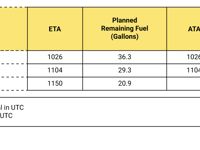
The figure shows part of a flight plan and fuel log covering the route from STRONE to KILDONAN, continuing on to PLADDA. Assuming the same groundspeed and conditions on the KILDONAN-PLADDA segment, and that fuel consumption per minute is consistent with the STRONE-KILDONAN leg, how much fuel should remain on arrival at PLADDA?
Given (from the table):
- Actual remaining fuel at STRONE = 36.3 gal (ATA 10:26)
- Actual remaining fuel at KILDONAN = 29.6 gal (ATA 11:04)
- Planned/expected arrival at PLADDA = ATA 11:50 (so the KILDONAN → PLADDA leg time is 11:04 → 11:50)
Step 1: Calculate the elapsed times for each leg
STRONE → KILDONAN: 10:26 → 11:04
11:04 − 10:26 = 38 minutes
KILDONAN → PLADDA: 11:04 → 11:50
11:50 − 11:04 = 46 minutes
Step 2: Find the fuel used on the STRONE → KILDONAN leg
Fuel at STRONE − Fuel at KILDONAN = 36.3 − 29.6 = 6.7 gallons
Step 3: Compute fuel flow (gallons per minute) for that leg
- Fuel flow = 6.7 gal ÷ 38 min = 0.176315789… gal/min (we can round sensibly to 0.1763 gal/min for projections).
Step 4: Project burn for the KILDONAN → PLADDA leg (46 minutes)
Multiply fuel flow by time:
- 0.1763 × 46 = 8.1 gal
Step 5: Subtract the projected burn from the actual fuel at KILDONAN
Fuel at KILDONAN − projected burn = 29.6 − 8.1 = 21.5 gallons
Your Notes (not visible to others)
This question has appeared on the real examination, you can find the related countries below.


 Use Keyboard Shortcuts
