

The human eye can control the amount of light that enters it. Which of the following is resposible for that function?
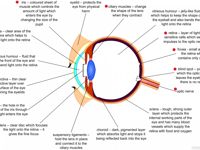
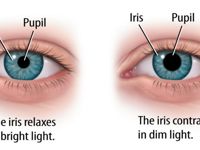
Refer to figures.
Do not worry about learing every function in the figure, but it explains well the different functions. The items marked with a red dot are the important items to know, and they will appear in questions. Some of the others may become relevant if you proceed to ATPL exams, or are just interested!
The retina --> INCORRECT. This is the light sensitive inner lining of the eye. It senses light and converts it to electrical impulses which are sent to the brain through the optic nerve, where they are processed by the optic nerve in to what we see.
The cornea --> INCORRECT. This is the outer front of the eye that you would touch if you touched your eyeball. It does not move (it is "fixed") and it is resposible for focusing about 70% of the light that reaches the eye by bending it towards a focal point on the retina.
The lens --> INCORRECT. This is resposible for focusing the remaining 30% of the light. It changes shape to accurately focus the light on the retina and produce a clear image, and adapts to light that is far away or close to the eye by bending the light more or less as needed.
The iris --> CORRECT. This is the coloured part of the eye that lets more or less light in. It does not focus, it does not receive electrical signals, it simply gets bigger or smaller to allow enough light in to see, but not too much or you might damage your retina by burning it. In dim/low light conditions it gets bigger to allow the maximum amount of light in. In bright light conditions it gets smaller to protect the eye and only allow the light needed for vision in.
Your Notes (not visible to others)
This question has appeared on the real examination, you can find the related countries below.
-
Portugal1


 Use Keyboard Shortcuts
