

Which are the official basic units for horizontal distances used in aeronautical navigation and their abbreviations?
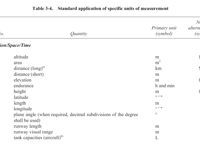
Refer to figure.
ICAO Annex 5
Units of Measurement to be Used in Air and Ground Operations
CHAPTER 3. Standard Application of Units of Measurement
3.1 SI units
3.1.1 The International System of Units developed and maintained by the General Conference of Weights and Measures (CGPM) shall, subject to the provisions of 3.2 and 3.3, be used as the standard system of units of measurement for all aspects of international civil aviation air and ground operations.
3.2 Non-SI units
3.2.1 Non-SI units for permanent use with the SI
The non-SI units listed in Table 3-2 shall be used either in lieu of, or in addition to, SI units as primary units of measurement but only as specified in Table 3-4.
3.2.2 Non-SI alternative units permitted for temporary use with the SI
The non-SI units listed in Table 3-3 shall be permitted for temporary use as alternative units of measurement but only for those specific quantities listed in Table 3-4.
Table 3-4. Standard application of specific units of measurement
Ref. No: 1.3 distance
Primary unit (symbol): km
Non-SI alternative unit (symbol): NM
Note: As used herein the term SI unit is meant to include base units and derived units as well as their multiples and sub-multiples.
Your Notes (not visible to others)
This question has appeared on the real examination, you can find the related countries below.
-
Austro Control6
-
Greece1
-
Slovenia1


 Use Keyboard Shortcuts
