

Considering an aerofoil at a low angle of attack, where will the separation point be located?
Refer to figures.
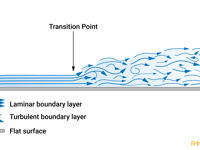
When air flows over a surface, the air in contact with the surface stops. A thin film called the boundary layer forms over the aerofoil, as the air near the surface slows down. To begin with, the air will flow in layers (or "lamina") over the surface - this is called Laminar Flow. Eventually, the flow de-stabilises and becomes chaotic. This is called Turbulent flow. The location where this occurs is called the transition point.
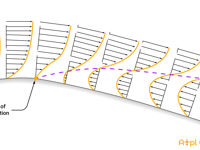
On an aerofoil, air first accelerates over the top surface. However, it then faces what's known as an adverse pressure gradient which slows it down again. The air in the boundary layer can slow down so much that the flow reverses direction - which leads to boundary layer separation. The point where this occurs is the separation point.
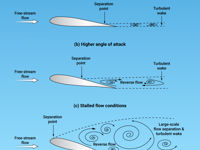
As the angle of attack increases, the adverse pressure gradient becomes stronger. As such, the boundary layer separates earlier, further forward along the aerofoil.
At low angles of attack the boundary layer only separates very late, towards the trailing edge on the upper surface of the aerofoil.
Note: The leading edge is the front of the aerofoil, and the trailing edge is the back.
There is not a very strong adverse pressure gradient on the lower surface of the aerofoil with positive angles of attack, so bondary layer separation typically does not occur here.
Your Notes (not visible to others)
This question has appeared on the real examination, you can find the related countries below.


 Use Keyboard Shortcuts
