

Stabilization around the lateral axis during cruise is achieved by the…
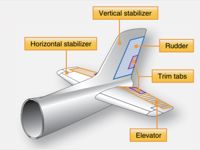
Refer to figure.
The three axes of an airplane intersect at the center of gravity (CG) and are those about which an airplane moves in flight. They are the longitudinal, the lateral and the normal axes. If the forces about any axis are not balanced there will be an angular acceleration and the airplane will rotate about that axis.
The lateral axis is a horizontal straight line passing from one side of the airplane to the other, through the CG, at right angles to the longitudinal axis. It is the axis about which the airplane moves, in response to a control input by the pilot or as the result of an external disturbance, by raising or lowering the nose of the airplane. Thus, it pitches about the lateral axis.
Stabilization around the lateral axis during cruise flight is therefore achieved by horizontal stabilizer and trim tabs are used on the stabilizer to reduce control forces.
Your Notes (not visible to others)
This question has appeared on the real examination, you can find the related countries below.
-
Austro Control1


 Use Keyboard Shortcuts
