

Where does the inclination reach its lowest value?
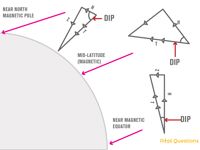
Refer to figure.
The Earth has a magnetic field that has the same properties as any other simple magnet you may have seen. Because of this, the Earth’s magnetic field consists of magnetic field lines flowing from one pole to another. These lines have some properties that are very important to understand as they greatly affect our navigation on Earth and thus, our navigation instruments such as the magnetic compass.
In fact, these magnetic lines are not straight lines spread equally around the Earth. They are straight and horizontal close to the equator, but the higher the latitude, the more these lines tend to converge towards the Earth’s poles. Therefore, they will become more and more inclined until being fully vertical at the pole. The angle between the horizontal plane and the vertical component of the magnetic field lines of the Earth is called the dip angle or inclination.
The inclination will have a value of almost 90° at the magnetic poles - highest value (increased vertical magnetic field) and will be almost null - lowest value at the magnetic equator (low vertical component – high horizontal component).
As a consequence, the pendulous magnet will also increasingly tilt towards its vertical and produce greater instrument errors (turning, acceleration…).
Your Notes (not visible to others)
This question has appeared on the real examination, you can find the related countries below.
-
Austro Control1


 Use Keyboard Shortcuts
