

At which of the following latitudes is the phenomenon known as 'magnetic dip' the largest?
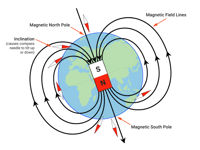
Refer to figure.
A compass is simply a magnet which is free to rotate. It works by aligning with the Earth's magnetic field lines, and points to where magnetic North is. We use compasses for navigation around the globe, and are only concerned with the horizontal component of the Earth's magnetic field. However, looking at the figure, we can also see that there is a vertical component too. This vertical component is known as the inclination of the magnetic field (and sometimes the angle is also called the "dip angle").
The magnets in direct-reading compasses try to align with the field lines - including the vertical component. This causes one side of the compass to dip which leads to errors in the compass reading during turns, or when accelerating.
As we can see from the figure, there is almost no inclination near the equator - and so no dip error. At higher latitudes (either North or South - it doesn't make much of a difference) the inclination/dip increases until reaching 90° at the poles. Near the poles, the horizontal component of the magnetic field isn't strong enough for magnetic compasses to function properly.
So, the magnetic dip will be highest at whatever the highest latitude in the question is - that is, 60° North.
Your Notes (not visible to others)
This question has appeared on the real examination, you can find the related countries below.


 Use Keyboard Shortcuts
