

What weather conditions can be anticipated during conditionally unstable conditions?
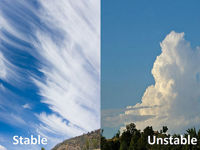
Refer to figure.
Stable air inhibits vertical motion and tends to result in calm (though not necessarily favorable) weather, whereas unstable air can lead to turbulence and severe weather.
The table below outlines the differences in weather expected between stable and unstable atmospheric conditions:
| Stable conditions | Unstable conditions | |
| Clouds | Stratiform clouds and fog. Clouds tend to be flat or layered since vertical development is limited. These are known as stratiform clouds. | Cumuliform clouds. Strong rising air currents produce clouds with significant vertical extent, typically cumuliform clouds. |
| Precipitation | Continuous precipitation. Precipitation, if present, is typically light in intensity but can persist due to the extensive horizontal coverage of the cloud. However, these clouds cannot produce large raindrops or hail. Expect drizzle, fine rain, snow, or snow grains. | Showery precipitation. Precipitation tends to be reasonably intense due to the vertical cloud formations that can hold large quantities of water. This results in large raindrops and hail, falling in relatively short but intense showers since such clouds usually lack extensive horizontal coverage. |
| Visibility | Fair to poor visibility in haze and smoke. Atmospheric contaminants such as dust and smoke remain near the surface due to the lack of vertical movement, leading to poor visibility often characterized by haze, fog, or mist. | Good visibility except in blowing obstructions. Visibility is generally good as smoke and dust particles near the surface are carried upwards. However, visibility can become very poor during rain or hail showers. |
| Turbulence | Smooth air. Turbulence is generally minimal or absent due to the stagnant vertical airflow in stable conditions. However, there are important exceptions to this general rule. | Rough air (turbulence). The strong vertical air movement generates moderate to severe turbulence. |
Your Notes (not visible to others)
This question has appeared on the real examination, you can find the related countries below.
-
Austro Control1
-
Malta1


 Use Keyboard Shortcuts
Use your keyboard for faster navigation
