

Refer to figure.
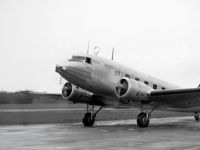
Which radio navigation aid can be received by the circular aerial on the top of the fuselage?
Refer to figure.
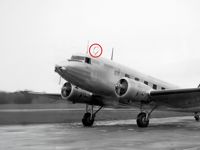
The circular aerial on top of the fuselage is typically associated with receiving signals from Non-Directional Beacons (NDBs). These systems use rotating loop aerials, which are often positioned on the top of the fuselage, to receive vertically polarised NDB signals.
VHF Omnidirectional Radio Range (VOR) aerials are typically dipoles that operate in the VHF frequency range and are horizontally polarised. They can often be seen as 'V' shaped aerials on the fin of an aeroplane, with each half of the 'V' being a quarter wavelength, making up a half wave dipole in total. These aerials are designed to receive the horizontally polarised signals transmitted by VOR stations, which are used for navigation purposes.
Distance Measuring Equipment (DME) are used to measure the slant range to a beacon. They are typically small and can be mounted on various parts of the aircraft, often on the underside of the fuselage.
VHF Direction Finder (VDF) are used for VHF Direction Finding, typically consists of a series of dipoles arranged in a circle, known as Adcock aerials. Each dipole receives a slightly different phase of the incoming signal, and the difference in phase helps determine the direction from which the signal is coming. This setup allows the VDF system to provide bearings to aircraft based on the direction of the received signal.
Your Notes (not visible to others)
This question has appeared on the real examination, you can find the related countries below.


 Use Keyboard Shortcuts
