Which statement correctly describes the physical characteristics of cirrostratus cloud?
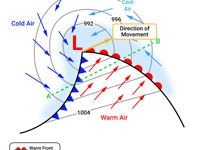
Refer to figures.
Cirrostratus (Cs) is a high-level sheet cloud belonging to the cirrus family, typically found above 23000 ft in temperate latitudes. It is composed entirely of ice crystals and appears as a thin, whitish, fibrous or smooth veil that covers most or all of the sky.
Cirrostratus is translucent enough to allow the sun and moon to be visible through it, and its ice crystals refract sunlight to produce the characteristic halo phenomenon (a ring of light around the sun or moon). The halo is one of the most reliable and distinctive indicators of cirrostratus presence and serves as a practical visual warning of an approaching warm front. Cirrostratus typically appears in the cloud sequence of an approaching warm front following cirrus, as the frontal cloud sheet thickens and lowers. It does not produce precipitation.
A thin, high level cloud, covering most of the sky, composed of ice crystals → CORRECT. This precisely describes cirrostratus: high altitude (above FL230), thin and widespread, ice crystal composition, covering large areas of sky. The ice crystals produce the characteristic halo phenomenon when aligned with the sun or moon. This is the correct answer.
A dense, low-level cloud associated with heavy rain → INCORRECT. A dense low-level cloud producing heavy rain is nimbostratus or cumulonimbus. Cirrostratus is high-level, thin, and produces no surface precipitation. The description is the opposite of cirrostratus characteristics.
A mid-level cloud consisting of water droplets and ice → INCORRECT. A mid-level cloud consisting of water droplets and ice is altostratus, found between approximately 6500 and 23000 ft. Cirrostratus is high-level (above 23000 ft) and composed exclusively of ice crystals, not water droplets.
A vertical cloud with a flat base and cauliflower-like top → INCORRECT. A vertical cloud with a flat base and cauliflower top is a cumulus (Cu) or cumulonimbus (Cb). These are convective clouds with vertical development, entirely different from the thin widespread horizontal sheet of cirrostratus.
Your Notes (not visible to others)
This question has appeared on the real examination, you can find the related countries below.