

What is the meteorological process that leads to the formation of an occluded front?
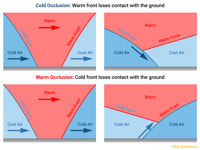
Refer to figure.
In a mid-latitude depression (extratropical cyclone), a warm front precedes the low centre and a cold front follows it, with a warm sector of warm air between them. Cold fronts travel faster than warm fronts because cold air is denser and advances more rapidly. As the depression matures, the cold front gradually catches up to the warm front ahead of it.
When the cold front overtakes the warm front, the warm sector air between them is lifted entirely off the surface, and the two fronts merge into a single occluded front.
In a cold occlusion the cold air behind the cold front is colder than the cold air ahead of the warm front, so the cold front undercuts the warm front air and pushes it upward.
In a warm occlusion the air behind the cold front is less cold than the air ahead of the warm front, so the cold front rides over the warm frontal surface.
A cold front overtakes a warm front → CORRECT. This is the precise definition of occlusion formation. Cold fronts travel faster than warm fronts in a developing depression. When the cold front catches the warm front, the warm sector is lifted off the surface and an occlusion forms.
A warm front overtakes a cold front → INCORRECT. Warm fronts are slower than cold fronts, not faster. The sequence is always cold front catching warm front, not the reverse. A warm front cannot overtake the cold front that follows it.
A high-pressure system meets a low-pressure system → INCORRECT. A high meeting a low describes the pressure gradient between systems that drives wind flow, not the formation of an occluded front. Occlusion is specifically a frontal process within a depression involving two air masses and two frontal boundaries.
Two air masses of equal temperature meet and become stationary → INCORRECT. Two air masses of equal temperature meeting and stagnating describes a STATIONARY FRONT, not an occluded front. A stationary front forms when neither air mass is advancing. Occlusion requires three air masses of different temperatures and the specific overtaking of one front by another.
Your Notes (not visible to others)
This question has appeared on the real examination, you can find the related countries below.


 Use Keyboard Shortcuts
