

Which atmospheric force is responsible for the leftward deflection of moving air in the southern hemisphere?
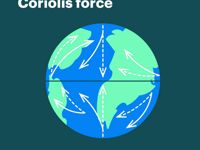
Refer to figure.
The Coriolis force (or Coriolis effect) is an apparent force that acts on any moving object in a rotating reference frame such as the rotating Earth. It results from the Earth's rotation causing points at different latitudes to have different tangential velocities.
A parcel of air moving horizontally is deflected by the Coriolis force:
- To the RIGHT in the northern hemisphere
- To the LEFT in the southern hemisphere.
The magnitude of the Coriolis force is proportional to wind speed and latitude, being zero at the equator and maximum at the poles. The Coriolis force does not change the speed of the wind, only its direction. It is the Coriolis deflection that causes winds to circulate clockwise around lows and anti-clockwise around highs in the southern hemisphere (opposite to the northern hemisphere).
CF = 2 Ω ρ V sin θ, where:
| Ω ρ V θ | = angular rotation of the earth = density = wind speed = latitude |
Coriolis force → CORRECT. The Coriolis force deflects moving air to the left in the southern hemisphere and to the right in the northern hemisphere. This is the fundamental cause of cyclonic rotation directions, trade wind deflection, and all large-scale atmospheric circulation patterns being mirror images between hemispheres.
Pressure gradient force → INCORRECT. The pressure gradient force acts perpendicular to isobars and drives air from high to low pressure. It initiates air movement but does not deflect it left or right: it acts in the direction of the pressure gradient. Once air starts moving, the Coriolis force causes the deflection.
Centrifugal force → INCORRECT. Centrifugal force is the apparent outward force experienced by an object in circular motion. It plays a role in the gradient wind balance for curved flow but does not specifically cause left deflection in the southern hemisphere as a general phenomenon. It is not the cause of the hemispheric deflection described in the question.
Frictional force → INCORRECT. Frictional force opposes the wind direction and reduces its speed near the surface. It causes wind to cross isobars toward low pressure (deflecting toward the low) rather than flowing parallel to them. This is not the same as the leftward deflection caused by the Coriolis force and applies only in the boundary layer.
Your Notes (not visible to others)
This question has appeared on the real examination, you can find the related countries below.


 Use Keyboard Shortcuts
