

In meteorological terminology, what does the term backing specifically describe when applied to wind?
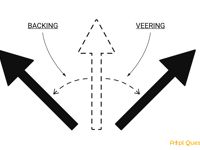
Refer to figure.
Backing and veering are specific meteorological terms describing changes in wind direction over time at a fixed point, or with altitude. Backing refers to an anti-clockwise change in wind direction: for example a wind changing from south to south-east to east is backing.
Veering refers to a clockwise change: for example south to south-west to west to north-west is veering. In South Africa, backing at the surface is associated with cold front passage (NW to SW is anti-clockwise = backing) and worsening weather.
These definitions are internationally standardised and do not change between hemispheres: backing is always anti-clockwise and veering is always clockwise.
A wind that is changing in an anti-clockwise direction → CORRECT. Backing is by definition a wind direction change in the anti-clockwise sense when viewed from above, whether the change occurs over time or with increasing altitude. This is the standard and universally accepted definition.
A wind that is changing in a clockwise direction → INCORRECT. A clockwise change in wind direction is VEERING, not backing. These two terms are direct opposites and must not be confused.
An increase in wind speed over a short period → INCORRECT. A rapid increase in wind speed is described by terms such as squall or gust. Backing describes only the DIRECTION of change, not speed.
A decrease in wind speed as altitude increases → INCORRECT. This describes a negative wind shear or wind decay with height, which is a completely different concept unrelated to the directional meaning of backing.
Your Notes (not visible to others)
This question has appeared on the real examination, you can find the related countries below.


 Use Keyboard Shortcuts
