

On a Lambert’s Conformal Conic projection chart, a rhumb line track…
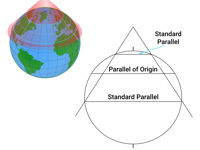
Refer to figure.
In a Lambert Conformal Conic projection, the cone cuts through the Earth at two specific latitudes, called “Standard Parallels”. At these two parallels, the scale of the chart matches the scale of the Earth, because the standard parallels are the same on the globe as on the cone.
“Parallel of origin” is the latitude exactly midway between the standard parallels, where scale is at its minimum (most contracted) and the cone is parallel to the tangent.
When the cone is unwrapped, or developed, it can be seen that the meridians of longitude are straight lines and converge (slope in) at a constant angle towards the nearer pole and the rhumb lines, like parallels of latitude, are curves concave to the pole.
In a Lambert Conformal Conic projection great circles, like meridians, are straight lines and the rhumb lines, like parallels of latitude, are curves concave to the pole.
In general, regardless of the chart projection:
- Great circles are lines, which if extended would form a circumference on the Earth and these tracks mark the shortest distance. But, due to converging meridians, they have a changing track, because they cut every meridian at a different angle.
- Rhumb lines are lines with constant direction, i.e. cut each meridian at the same angle, but these tracks do not mark the shortest distance.
Your Notes (not visible to others)
This question has appeared on the real examination, you can find the related countries below.


 Use Keyboard Shortcuts
