

The point that separates laminar flow from turbulent flow is called…
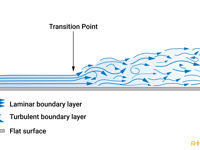
Refer to figure.
The boundary layer is the thin layer of air at the surface where air is slowed down due to skin friction. It exists because of the friction at the surface, and the friction between neighbouring layers of air flowing over each other (viscosity). The boundary layer usually begins as a laminar boundary layer with laminar flow. This is when air flows as thin sheets ("laminae") of air, where each layer is slowed down by the neighbouring layer.
Turbulent flow exists under conditions where it isn't possible for air to flow in a laminar manner. Turbulent flow is unstable, and contains lots of rotating eddy currents. As air flows through the boundary layer, it may transition from laminar to turbulent flow. The point at which this occurs is called the transition point.
Turbulent flow contains more energy than laminar flow, mainly due to the rotating vortices and eddy currents. It therefore removes more energy from the aircraft, and so designers usually design most aircraft surfaces to support laminar flow for as long as possible, keeping the transition point as far downstream as possible. There are some exceptions, including on the upper surface of the wing at high angles of attack - because turbulent flow helps to resist boundary layer separation and stall.
the centre of pressure. → INCORRECT. The centre of pressure (CP) is the point through which the aerodynamic force of the wings appears to act.
the centre of lift. → INCORRECT. This is another way to refer to the CP, although it is not the term used by SACAA in the PPL syllabus.
the separation point. → INCORRECT. This is the point where the boundary layer detaches (or separates) from the wing, at high angles of attack, due to the adverse pressure gradient.
the transition point. → CORRECT
Your Notes (not visible to others)
This question has appeared on the real examination, you can find the related countries below.


 Use Keyboard Shortcuts
