

Which of the following types of control balance is most commonly used on light aircraft to reduce the effect of flutter in-flight?
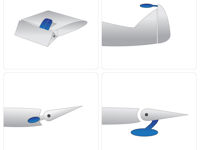
Refer to figure.
Flutter is an incredibly dangerous phenomenon that can happen to an aircraft. It is a type of aeroelastic vibration, where the aerodynamic forces on the wing interact with the fact that the wing flexes and twists. It is only likely to happen after certain flight control problems, or at very high speeds (high IAS). Aircraft are often speed limited by the possibility of flutter, and as it happens at high speeds, the rapidly changing forces have been known to destroy aircraft.
In this case, we are talking about control surface flutter, usually on ailerons or elevators. Lets think about an aileron for a moment. If an aileron is slightly deflected upwards, then the force on the aileron is downwards, and this not only pushes the aileron back to neutral, but it also first twists the wing trailing edge slightly downwards, which makes the upward aileron deflection a little larger initially.
When the aileron finally catches up and goes back to neutral, it will overshoot and deflect downwards due to the momentum and the wing un-twisting. This gets much more excessive quite quickly, as the aileron is now deflected downwards, with a wing twisted more upwards, and the cycle continues. The control surface ends up lagging behind the twist of the wing, and the only thing stopping this deviation from getting larger is that the wing can only twist so much. It will, of course, eventually break under the forces.
The classic method for reducing flutter, is to place a mass balance, attached to the aileron, further forwards of the hinge point. This stops the CG of the aileron being so far back, bringing the CG closer to the hinge line (which is optimal) and this CG movement means that the aileron is much less affected by the momentum of going up or down, which is what makes flutter worse. This doesn't usually eliminate flutter entirely, as it's difficult and heavy to put enough weight that far ahead of the hinge line, however, it will increase the speed at which flutter occurs, until that speed is outside of the normal operating envelope.
As for the other options:
- A mass balance. → CORRECT. As discussed above, a mass balance is a commonly used method of reducing flutter, and this is its only purpose.
- An inset hinge balance. → INCORRECT. This is not a balance, but the point of having the hinge “inset" into the control surface means that control forces are reduced (make it easier for the pilots). It can address flutter in some way, but not as much as a mass balance, which only addresses flutter.
- A spring bias trimmer. → INCORRECT. They are likely talking about a spring tab here, that's another system that reduces control loads in flight and can provide some form of artificial control feel, it isn't a flutter prevention device.
- A servo tab balance. → INCORRECT. Again, a servo tab is similar to a spring tab, it isn't a flutter prevention device.
Your Notes (not visible to others)
This question has appeared on the real examination, you can find the related countries below.


 Use Keyboard Shortcuts
