

Extending trailing edge flaps causes which of the following?
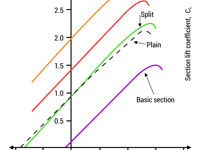
Refer to figure.
Trailing edge flaps are designed to increase the wing camber (and sometimes the wing's area as well), which increases the maximum lift that the aerofoil can produce. Their primary purpose is to decrease the aircraft's stall speed. This is useful mostly to allow the aircraft to take-off and land in shorter distances, as it can allow the aircraft to fly slower.
Extending trailing edge flaps allows for a higher camber of wing, and improves the lift coefficient of the wing, so it can produce enough lift at lower speeds than a clean wing, hence the lower stall speeds. Secondarily, they are useful for increasing drag.
Whilst flaps increase the maximum coefficient of lift, their high camber means that they do stall at a lower angle of attack than a clean wing, therefore their critical AoA is lower (but they are still producing more lift at this AoA than the clean wing could do).
Going through the options:
- “A decrease in lateral stability.” → INCORRECT. The lateral stability is how the aircraft reacts in roll to a sideslip condition, and flaps would be likely to increase lateral stability, due to dihedral being more powerful with flaps extended.
- “A decrease in the stalling angle of attack.” → CORRECT. The stalling angle of attack is more commonly called the critical angle of attack, and this is decreased due to the higher camber when the trailing edge flaps are extended.
- “An increase in longitudinal stability.” → INCORRECT. Extending flaps tends to cause longitudinal stability (pitch stability) to decrease due to the reduced dynamic pressure over the horizontal stabiliser.
- “An increase in aileron effectiveness.” → INCORRECT. Extending flaps will have little effect on aileron effectiveness, and if anything will decrease effectiveness.
Your Notes (not visible to others)
This question has appeared on the real examination, you can find the related countries below.


 Use Keyboard Shortcuts
