

You notice dust on the wing before flight, and after flight, you see that the same dust is still there. This is because of…
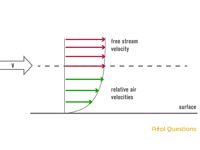
Refer to figure.
What the examiner is getting at here is that the fast moving airflow over the wing never actually touches the surface of the wing. There is a thing called the boundary layer, which can be less than a millimeter deep, separating the full speed air from the wing surface itself.
Due to the skin friction between the wing surface molecules and the air molecules, the first layer of air molecules that touches the wing is actually completely stationary in relation to the wing. This is where the dust might lie (if the dust particles are small enough). The layer of air particles above this one are moving slightly faster, and the layer above this are moving slightly faster again, etc., until the air particles are moving at the “free stream velocity”, which just means they are in the normal airflow, unaffected by the wing nearby.
This boundary layer is what creates skin friction drag as air flows past an object, due to the viscosity (internal friction) between air particles, and the fact that each layer is being partially slowed down by the layer beneath it (closer to the wing).
Boundary layers are initially in uniform layers as described above, called laminar boundary layers, but do eventually become turbulent, with a bit more mixing between layers, further along the wing.
You will reference boundary layers more when discussing the stall.
Your Notes (not visible to others)
This question has appeared on the real examination, you can find the related countries below.


 Use Keyboard Shortcuts
