3 / 20

Which of the following is a key factor affecting the longitudinal stability of an aeroplane?

  • A

    The size of the elevator.

  • B

    The position of the centre of gravity relative to the centre of pressure.

  • C

    The aspect ratio of the wings.

  • D

    The angle of incidence of the wings.

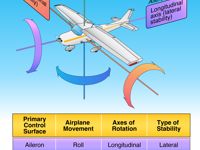
Refer to figure.
Stability is the measurement of an aircraft's aerodynamic reaction to a displacement from its equilibrium position. As longitudinal stability is stability in pitch, this is when the aircraft is trimmed out, in straight and level flight, for instance, but another force causes it to pitch up or pitch down from the trimmed attitude. This other force could be a gust of wind, the flight controls, or anything else really.

Imagine a plane that is momentarily pitched upwards by this “other force”, if it is longitudinally stable in pitch, it will naturally pitch downwards without pilot input, back towards the equilibrium position. A longitudinally unstable aircraft would continue pitching upwards, further from the equilibrium.

Stability is like a bowl with a ping pong ball inside. If the ball starts at the bottom and is moved sideways, it will always roll back down to the bottom of the bowl (the equilibrium position). If you turn the bowl upside-down, any movement of the ball from the centre will cause it to roll away faster and faster, and that would be instability. A flat plate is neutrally stable, that is the state in between stable and unstable.

There are actually two types of stability, static and dynamic. We are discussing static stability here.


In an aircraft, the CG (centre of gravity) is the most important point in determining stability. In flight, the aircraft always rotates around the centre of gravity. If the centre of gravity is in its allowable range, the aircraft should behave predictably and be stable. If the CG is too far forwards, the aircraft will be too stable, and manoeuvring will be difficult. If the CG is too far aft, then the aircraft will become unstable, and will be almost impossible to control. Stability is directly opposed to manoeuvrability, and if one decreases, the other increases.

The centre of pressure is mentioned in the correct answer also, and that has a much more complex relationship with stability. Each component of the aircraft has a centre of pressure, where the aerodynamic effects of lift and drag act through, but most are incredibly difficult to calculate and change with the angle of the relative airflow. The whole aircraft is considered to have a certain “neutral point”, which is a little bit like the average centre of pressure for the whole aircraft, for stability terms, and as long as the CG is ahead of this point, the aircraft will have at least a little bit of positive static stability.

Going through the options:

  • “The size of the elevator.”
    • INCORRECT → The elevators are control surfaces used to control pitch. They are nothing to do with the stability of the aircraft. Stability is measured without pilot intervention.
  • The position of the centre of gravity relative to the centre of pressure.
    • CORRECT → The centre of gravity location  is highly important to the stability of the aircraft, and this is indeed in relation to various centres of pressure, though saying “centre of pressure” is an oversimplification.
  • “The aspect ratio of the wings.”
    • INCORRECT → The aspect ratio of a wing is the span divided by the chord, and affects drag primarily, but has very little impact on longitudinal stability. Any impact it does have is way above the syllabus level.
  • “The angle of incidence of the wings.”
    • INCORRECT → The angle of incidence of the wings is the angle of their chord line in comparison to the aircraft's longitudinal axis. It sets the aircraft pitch attitude vs wing AoA, but has little impact on longitudinal stability. Again, there is actually a small impact but it is far above the syllabus level.

Your Notes (not visible to others)


This question has appeared on the real examination, you can find the related countries below.