

Regarding aircraft wings, the term “aspect ratio” means which of the following? The ratio of…
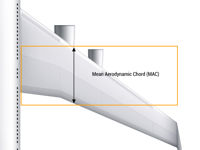
Refer to figure.
Aspect ratio (AR) of the ratio of wingspan to chord length, and is therefore calculated as follows.
- AR = span/chord
For more complicated wings than a simple rectangle, this can also be the following;
- AR = span / average chord,
or it can all be multiplied by the wingspan again to become;
- AR = span2 / wing area
As the average chord x span = wing area.
The “mean aerodynamic chord” is the “average chord length" of the wing, as if the wing were replaced by a rectangular wing of the same aerodynamic properties.
Therefore, the aspect ratio could be described as the ratio of the wingspan to the mean aerodynamic chord, which is the correct answer.
A high aspect ratio wing is long and thin, like a glider wing, however a low aspect ratio wing has only a short wingspan but a longer chord length, like a fighter jet wing, or Concorde.
High aspect ratio wings are very efficient, as they reduce the effect of wingtip vortices, and thereby decrease induced drag. This is because the wingtip is situated quite far away from the majority of the wing, and the lift is spread out so the vortices are less strong. Low aspect ratio wings, on the other hand, produce strong wingtip vortices and these are close to the wing itself so produce a lot of induced drag.
Your Notes (not visible to others)
This question has appeared on the real examination, you can find the related countries below.


 Use Keyboard Shortcuts
