

What is the name given to the angle between the chord line and the relative airflow?
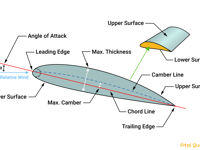
Refer to figure.
The chord line is the line drawn from the leading edge to the trailing edge of the aerofoil section.
The angle between the chord line and the relative airflow is known as the angle of attack. This is a very important quantity, as when the angle of attack becomes too high - the wing will stall. There is also a proportional relationship between angle of attack (AoA) and coefficient of lift (CL). So, by increasing the AoA, we can increase the CL.
The anhedral angle → INCORRECT
- Anhedral is the angle that the wings make with the lateral axis, when viewed from the front. Anhedral exists when the wings are angled downwards.
The angle of attack → CORRECT
The dihedral angle → INCORRECT
- The dihedral angle is the angle the wings make with the lateral axis when viewed from the front. The wings are typically angled slightly upwards to provide lateral stability. When they are angled downwards, this is referred to as anhedral.
The angle of incidence → INCORRECT
- The angle of incidence is the angle between the longitudinal axis, and the the chord line at the wing root. It is a design angle, which describes how the wings have been bolted to the fuselage. Formerly, this term may have been used to describe the angle of attack but it is no longer used in this context.
Your Notes (not visible to others)
This question has appeared on the real examination, you can find the related countries below.


 Use Keyboard Shortcuts
