

In a Direction Indicator (DI), what causes apparent wander?
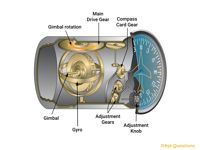
Refer to figure.
The gyro in the DI will drift over time due to real wander caused by aircraft manoeuvres or mechanical friction and apparent wander caused by Earth rotation and transport drift. Aparent wander is caused by the changing orientation of the observer relative to the gyro's orientation in space.
Earth Rotation - Like all gyros, the directional gyro retains its orientation in space but Earthbound observers don't. Because the Earth is rotating at 15 degrees per hour, to an observer the gyro will appear to drift at a rate of 15 degrees, multiplied by the sine of the latitude, per hour. Therefore drift will be zero at the Equator and maximum at the poles.
Transport Wander - the same apparent drift as Earth rotation will be observered if the gyro is transported across the curved surface of the Earth. The amount of drift depends on the groundspeed and latitude.
Because the DI is only accurate for a short period of time it must be manually resynchronised with the DRC heading at regular intervals (every 10 mins). This synchronisation is achieved by pushing in the caging knob and turning it to reorient the display to the compass heading on the DRC. Synchronisation must be done in straight, level, unaccelerated flight to ensure that the indications of the DRC are correct and the gyro axis is horizontal.
a decrease in the aircraft's speed → INCORRECT. Aparent wander is caused by the rotation of the Earth and transporting a gyro across the surface of the Earth.
the rotation of the earth → CORRECT. This is one of the causes of apparent wander.
changes in aircraft pitch → INCORRECT. Sufficiently large pitch changes can cause a gyro to topple which is real wander not apparent wander.
bearing friction caused by wear → INCORRECT. This will cause real wander as opposed to apparent wander.
Your Notes (not visible to others)
This question has appeared on the real examination, you can find the related countries below.


 Use Keyboard Shortcuts
