

What happens to the capsule inside an altimeter as altitude is increased?
-
A
contract, causing the instrument to shown an increase in altitude and a decrease in the subscale reading
-
B
contract, causing the instrument to shown an increase in altitude
-
C
expand, causing the instrument to shown an increase in altitude
-
D
expand, causing the instrument to show an increase in altitude and a decrease in the subscale reading.
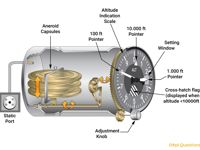
Refer to figure.
A barometric altimeter uses the same working principle as an aneroid barometer but it is calibrated to measure altitude instead of pressure. Atmospheric pressure is fed from the static ports to the instrument case giving the altimeter a continuous reading of ambient static pressure . A sealed aneroid capsule(s) inside the instrument case expands and contracts as the static pressure varies during climbs and descents and this is indicated on the instrument as a change in altitude.
To be of practical use the altimeter must be calibrated to a defined relationship between static pressure and altitude. This relationship is defined by the International Standard Atmosphere (ISA). At sea level ISA conditions are defined as:
- 1013.25 hPa or 29.92 inHg
- 15°C
- Pressure Lapse Rate approx 1 hPa per 30 ft or 1 inHg per 1000 ft (up to 5000 ft becoming more significant and non linear with increasing altitude)
Unfortunately actual atmospheric conditions are rarely the same as ISA so altimeters are fitted with a a method of setting a reference pressure on an altimeter sub scale. The altimeter will indicate altitude or height based on the difference between the sensed static pressure and the reference pressure using the ISA pressure lapse rate.
For example, if the reference pressure setting is 1000 hPa and the sensed static pressure is 980 hPa the altimeter will indicate 600 ft (20 hPa x 30ft).
contract, causing the instrument to shown an increase in altitude and a decrease in the subscale reading → INCORRECT. The capsule expands, the subscale reading can only be changed by the pilot.
contract, causing the instrument to shown an increase in altitude → INCORRECT. The capsule expands causing the instrument to show an incrase in altitude.
expand, causing the instrument to shown an increase in altitude → CORRECT. The reduction in static pressure in the sealed instrument case causes the capsule to expand causing the instrument to show an increase in altitude.
expand, causing the instrument to show an increase in altitude and a decrease in the subscale reading → INCORRECT. The subscale reading can only be changed by the pilot.
Your Notes (not visible to others)
This question has appeared on the real examination, you can find the related countries below.


 Use Keyboard Shortcuts
