

What is the most likely consequence of operating an aircraft with a tyre that has insufficient inflation pressure?
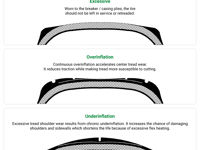
Refer to figure.
Tyre inflation pressure directly determines how the tyre contact patch distributes the aircraft load across the tread surface. When a tyre is correctly inflated, the contact patch is uniform and the load is distributed evenly across the full width of the tread, resulting in even wear.
When a tyre is under-inflated, the reduced internal pressure causes the tyre carcass to deform excessively under load. The sidewalls bulge outward and the central portion of the tread lifts slightly away from the runway surface, causing the outer edges of the tread to carry a disproportionate share of the load. This results in accelerated and concentrated wear on the outer shoulders of the tyre.
Note: The analogy with car tyres is directly applicable: an under-inflated car tyre shows wear on the outer edges of the tread for exactly the same reason. Conversely, an over-inflated tyre causes the contact patch to narrow and concentrate in the centre, producing excessive centre tread wear.
Excessive tread wear on the outside of the tyre → CORRECT. An under-inflated tyre deforms under load such that the sidewalls bulge and the tread centre lifts slightly, placing maximum contact pressure and friction on the outer shoulders of the tread. Sustained operation in this condition accelerates wear on the outer tread edges.
Flat spots in the centre of the tyre → INCORRECT. Flat spots are caused by wheel lockup during braking, where a stationary tyre slides along the runway surface and grinds away a localised area of tread. This is unrelated to inflation pressure and is an anti-skid or braking technique issue. Flat spots can appear anywhere on the tread depending on the wheel position during lockup, not specifically in the centre as a result of under-inflation.
Excessive tread wear in the centre of the tyre → INCORRECT. Centre tread wear is the characteristic result of OVER-inflation, not under-inflation. An over-inflated tyre is excessively stiff, the contact patch narrows and concentrates in the central tread region, and this central strip bears the majority of the load, causing accelerated centre wear. This option describes the opposite condition to that stated in the question.
Scuff marks along the surface of the whole tyre → INCORRECT. Uniform scuff marks across the entire tread surface would suggest a different type of tyre damage such as thermal degradation, chemical contamination, or a specific ground handling incident. Under-inflation does not produce uniform scuffing across the whole tread. The wear pattern produced by under-inflation is specifically concentrated on the outer edges, not distributed evenly across the full surface.
Your Notes (not visible to others)
This question has appeared on the real examination, you can find the related countries below.


 Use Keyboard Shortcuts
