

What may be the result when damage is caused to the cochlea?
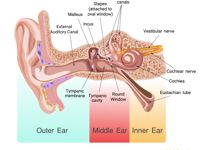
Refer to figure.
NOISE INDUCED HEARING LOSS (NIHL)
Noise Induced Hearing Loss is caused due to loud sounds. It occurs when the individual is exposed to a very loud sound (above 120 dB) momentarily such as an explosion, or when the individual is exposed to loud noises (above 85 dB) for prolonged periods of time such as working in a noisy environment. The hearing loss may at first be temporary but if the individual keeps being exposed to loud noise (above 85 dB) the problem will become permanent. The cochlea contains delicate hair cells responsible for hearing. When hearing loss is temporary, the hair cells are not permanently damaged, but they are temporarily impaired or “stressed”. Damage to the cochlea hair cells leads to permanent hearing loss because damage to these cells is usually irreversible. The individual loses the ability to hear the higher frequencies first, since they are detected at the outer part of the cochlea which is more sensitive to damage.
Let's examine the given options:
A blockage of the Eustachian tube. → INCORRECT. The cochlea is in the inner ear responsible for hearing, while the Eustachian tube is located in the middle ear and it is responsible to equalize pressure with the middle ear and the environment. These components work independently. The Eustachian tube is usually blocked due to a cold or congestion.
Temporary hearing loss that clears in 24 hours. → INCORRECT. When hearing loss is temporary, the hair cells are not permanently damaged, but they are temporarily impaired or “stressed”.
Permanent hearing loss. → CORRECT. Damage to the cochlea hair cells leads to permanent hearing loss because damage to these cells is usually irreversible.
Increased sensitivity to high-frequency sounds. → INCORRECT. The individual loses the ability to hear the higher frequencies when damage to the cochlea occurs, so sensitivity to high-frequency sounds decreases.
Your Notes (not visible to others)
This question has appeared on the real examination, you can find the related countries below.


 Use Keyboard Shortcuts
