

What is the ear component responsible to carry signals from the ear to the brain for interpretation as sound?
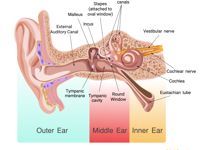
Refer to figure.
The human ear is responsible for two functions, sound reception (senses air vibrations) and balance-acceleration detection (senses accelerations of our body). To achieve these functions the human ear consists of three parts, outer, middle and inner ear.
OUTER EAR
The sound vibrations are entering the ear by the pinna, and then they travel through the auditory canal (Meatus) and finally reach the ear drum (Tympanium), which in turn vibrates.
MIDDLE EAR
Attached to the ear drum there are three tiny bones called ossicles (the malleus, incus and stapes or hammer, anvil and stirrup). Their purpose is to act as a bridge and transfer the sound vibrations from the outer to the inner ear. Part of the middle ear is the Eustachian tube which is connected to the back of the throat and equalizes the pressure between the middle ear and the environment.
INNER EAR
Attached to the stapes there is the oval window, which causes the fluid inside the cochlea to vibrate. Inside the cochlea there is a fine membrane covered with tiny hair-like cells. These hail-like cells movement depends on the frequency and loudness of the sound received. Their movement is detected by the auditory nerve and is transfered to the cortex of the brain, where it will be decoded into sound. Consequently, the part of the inner ear responsible for sound perception is the fluid-filled cochlea. There is another part of the inner ear called vestibular system, which is responsible for balance-acceleration detection.
Eustachian Tube → Balances the pressure between the middle and outer ear.
Vestibular nerve → Transmits signals related to balance and coordination from the inner ear to the brain
Optic nerve → Transfers visual information from the eye to the brain
Auditory nerve → Transmits electrical signals from the cochlea (inner ear) to the brain where they are decoded into sound
Your Notes (not visible to others)
This question has appeared on the real examination, you can find the related countries below.


 Use Keyboard Shortcuts
