

Which of the following surfaces will most effectively reduce wind speed due to ground friction?
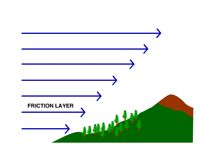
Refer to figure.
Wind speed is influenced by ground friction, which varies depending on the type of surface. Rougher surfaces create more friction and therefore reduce wind speed more effectively.
“Mountainous Areas with Vegetation Cover” → CORRECT.
- Mountainous terrain is inherently rough due to its varying elevations and obstacles. When combined with vegetation, the surface becomes even more irregular and rough, increasing friction. This high level of friction significantly slows down wind speed as air flows over and around obstacles.
"Flat Land with Lots of Vegetation Cover": → INCORRECT.
- Although flat, this type of land has a rough surface due to the presence of vegetation. Vegetation adds obstacles that increase ground friction. However, it has significantly less effect compared to mountainous areas.
“Flat Land, Deserted Land, No Vegetation” → INCORRECT.
- Flat and barren land presents very few obstacles. The smooth surface results in minimal friction, allowing wind to maintain higher speeds.
“Oceanic Areas”→ INCORRECT.
- The surface of the ocean is relatively smooth compared to land. Thus, oceanic areas exhibit very low friction and wind speeds remain relatively high.
Your Notes (not visible to others)
This question has appeared on the real examination, you can find the related countries below.
-
Austro Control4
-
Czech Republic1
-
Germany1
-
Malta1


 Use Keyboard Shortcuts
Use your keyboard for faster navigation
