10 / 20

The beam theory enables statements about the...

  • A

    energy conversion in an autorotation.

  • B

    power requirements during hover flight.

  • C

    transition lift close to the ground.

  • D

    drag in cruise flight.

Beam Theory, also known as engineer's Beam Theory or classical Beam Theory, is a simplification of the Linear Theory of elasticity, which provides a means of calculating the load-carrying and deflection characteristics of beams. It covers the case corresponding to small deflections of a beam that is subjected to lateral loads only.

A stationary hover is a manoeuvre in which the helicopter is maintained in nearly motionless flight over a reference point at a constant altitude and on a constant heading.

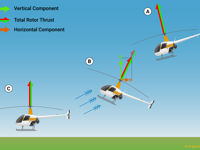
To lift a helicopter off the ground, a force must be produced greater than the weight, which acts vertically downwards through the aircraft’s Centre of Gravity (CG). On the ground with minimum pitch set, the total Rotor Thrust is small, and on some aircraft can even be negative, and the aircraft remains on the ground. As the Collective lever is raised blade pitch and the Angle of Attack are increased and the Total Rotor Thrust (TRT) becomes equal to Aircraft Gross Weight (also known as the All-Up Weight AUW) and the helicopter is resting only lightly on the ground. A further increase in Angle of Attack causes TRT to exceed the AUW and the helicopter accelerates vertically (in still air conditions).

Blades are subjected to bending stresses due to blade thrust producing and the lead-lag (acceleration - declaration) with reference to the plane of rotation.

In hover flight due to the increased power requirements, blade thrust is increased and due to the coning angle the blades have the tendency to accelerate.

Thus, the Beam Theory enables statements about the power requirements during hover flight.

Your Notes (not visible to others)


This question has appeared on the real examination, you can find the related countries below.

  • Austro Control
    1