

What is the advantage of a turbulent airflow compared to a laminar airflow at an aerofoil with a high angle of attack?
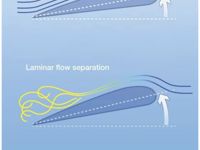
Refer to figure.
At high angles of attack, the behavior of airflow over an aerofoil significantly influences its aerodynamic performance. Here's how turbulent airflow offers advantages over laminar airflow in such conditions:
Enhanced Energy in the Boundary Layer:
- Turbulent Flow: Contains higher kinetic energy due to its chaotic and mixed nature. This energy enables the airflow to adhere better to the aerofoil's surface, especially around curves.
- Laminar Flow: While smooth and orderly, it possesses less energy, making it more susceptible to separating from the surface when challenged by adverse pressure gradients.
Delay in Flow Separation:
- Turbulent Boundary Layer: Its increased energy allows it to overcome adverse pressure gradients more effectively, maintaining attachment to the aerofoil surface longer. This delay in separation means the aerofoil can sustain lift at higher angles of attack before stalling.
- Laminar Boundary Layer: Tends to separate earlier under similar conditions, leading to a premature stall.
Improved Stall Characteristics:
- With Turbulent Flow: The transition to stall is more gradual, providing pilots with better warning and control.
- With Laminar Flow: Stall can occur suddenly, reducing reaction time.
Your Notes (not visible to others)
This question has appeared on the real examination, you can find the related countries below.
-
Austro Control1


 Use Keyboard Shortcuts
Use your keyboard for faster navigation
