

During an autorotation the airspeed is limited by...
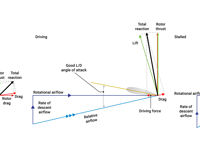
Refer to figure.
Autorotation is the state of flight where the main rotor disk of a helicopter is being turned by the action of air moving up through the rotor rather than engine power driving the rotor.
During vertical autorotation, the rotor disk is divided into three regions: driven region, driving region, and stall region.
The driven region, is nearest the blade tips. Normally, it consists of about 30 percent of the radius. In the driven region, the TAF acts behind the axis of rotation, resulting in an overall drag force. The driven region produces some lift, but that lift is offset by drag. The overall result is a deceleration in the rotation of the blade.
The driving region, or autorotative region, normally lies between 25 to 70 percent of the blade radius. Total aerodynamic force in the driving region is inclined slightly forward of the axis of rotation, producing a continual acceleration force. This inclination supplies thrust, which tends to accelerate the rotation of the blade. Driving region size varies with blade pitch setting, rate of descent, and rotor rpm.
The stalled region, the inner 25 percent of the rotor blade, operates above its maximum AoA (stall angle), causing drag, which tends to slow rotation of the blade.
Autorotative force in forward flight is produced in exactly the same manner as when the helicopter is descending vertically in still air. However, because forward speed changes the inflow of air up through the rotor disk, all three regions move outboard along the blade span on the retreating side of the disk where Angle of Attack (AoA) is larger.
With lower AoA on the advancing side blade, more of the blade falls in the driven region. On the retreating side, more of the blade is in the stall region. A small section near the root experiences a reversed flow, therefore, the size of the driven region on the retreating side is reduced.
During an autorotation the airspeed is limited by the drift of the driving forces on the returning blade.
Your Notes (not visible to others)
This question has appeared on the real examination, you can find the related countries below.
-
Austro Control1


 Use Keyboard Shortcuts
