

Which movement is caused by the Coriolis effect on the advancing rotor blade?
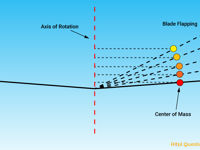
Refer to figure.
Coriolis Effect, which is sometimes referred to as conservation of angular momentum, might be compared to spinning skaters. When they extend their arms, their rotation slows down because the centre of mass moves farther from the axis of rotation. When their arms are retracted, the rotation speeds up because the centre of mass moves closer to the axis of rotation.
When a rotor blade flaps upward, the centre of mass of that blade moves closer to the axis of rotation and blade acceleration takes place in order to conserve angular momentum. Conversely, when that blade flaps downward, its centre of mass moves further from the axis of rotation and blade deceleration takes place.
Keep in mind that due to coning, a rotor blade will not flap below a plane passing through the rotor hub and perpendicular to the axis of rotation. The acceleration and deceleration actions of the rotor blades are absorbed by either dampers or the blade structure itself, depend- ing upon the design of the rotor system.
The Coriolis effect, in the context of a rotating system like a helicopter rotor, causes what is known as "precession" or a change in the direction of the rotating object. For an advancing rotor blade (the blade moving in the direction of travel), this effect induces a drag force that acts forward along the plane of rotation. This happens because the centrifugal force acts outward on the blade, but as the blade advances, the Coriolis effect causes a shift in the force vector to the component that moves forward. This forward drag movement is a result of the interplay between the rotational speed of the blade and the linear motion of the helicopter, leading to an acceleration component in the direction of travel. Therefore, drag movement forwards is the correct response due to the Coriolis effect's influence on the blade dynamics in a rotating system.
Your Notes (not visible to others)
This question has appeared on the real examination, you can find the related countries below.
-
Austro Control1


 Use Keyboard Shortcuts
